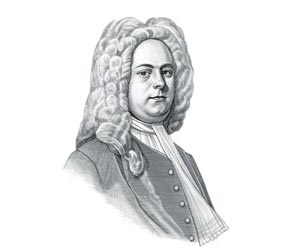
- Fact 2 - He was born in Halle in
Germany, February 23, 1685
- Fact 3 - His full name was George
Frederick Handel
- Fact 4 - His father was a barber
and surgeon, who intended his son to become a lawyer
- Fact 5 - As a little boy George
Frederick Handel practiced the harpsichord in the garret
- Fact 6 - Handel accompanied his
father on a visit to the home of the Duke of Saxe-Weissenfels
- Fact 7 - Handel played the organ
and gained the Duke's attention
- Fact 8 - The Duke advised the
father to let the boy study music
- Fact 9 - His first teacher of
Handel was Zachau, who taught him to play the organ and
harpsichord
- Fact 10 - After a few years Handel
went to Berlin with his teacher with Zachau
- Fact 11 - Handel then returned to
Halle, but after his father's death he went to Hamburg
- Fact 12 - At Hamburg the composer
and Johann Mattheson became good friends
- Fact 13 - George Frederick Handel
then lived in Italy for three years
- Fact 14 - Returning to Germany he
agreed to become Capellmeister to the Elector of Hanover
- Fact 15 - He failed to keep his
promise to the Elector by overstaying his leave of absence in
London
- Fact 16 - The Elector became King
of England. He was very angry at Handel for disobeying him
- Fact 17 - Handel won his favor
again by writing the Water Music for a royal boat procession on
the river Thames
- Fact 18 - For many years George
Frederick composed operas, but finally he won fame by writing
oratorios
- Fact 19 - He wrote the Messiah and
many other oratorios
- Fact 20 - George Frederick Handel
became blind toward the end of his life
- Fact 21 - He never met his fellow
countryman,
Johann
Sebastian Bach
- Fact 22 - George Frederick Handel
died on Good Friday, 1759
- Fact 23 - His music lives on and
the musical works of Handel include the following:
- Oratorios by Handel
- Messiah - 1741
Samson - 1741
Belshazzar - 1744
Joshua - 1747
Alexander Balus - 1747
Susanna - 1748
Solomon - 1748
Theodora - HWV 68 - 1749
The Choice of Hercules 1750
Jeptha - HWV 70 - 1751
The Triumph of Time and Truth - 1752
- Opera
- Almira - 1704
Nero - 1705
Rodrigo - 1707
Agrippina - 1709
Orlando - 1732
|